
Issue Shinkurushima Sanoyas Shipbuilding obtains the World’s First Approval …
페이지 정보
작성자 최고관리자 댓글 0건 조회 54회 작성일 26-03-31 10:33본문
Shinkurushima Sanoyas Shipbuilding obtains the World’s First Approval in Principle (AiP) for 'Liquefied CO2 Carrier intended to Socket SPAR Unit for injection facility'
Shinkurushima Sanoyas Shipbuilding is pleased to announce that it has obtained the world’s first Approval in Principle (AiP) from ClassNK for 'Liquefied CO2 Carrier intended to Socket SPAR Unit for injection facility' developed as part of the commissioned project of the Environmentally Friendly CCUS Demonstration Hub and Supply Chain Development Project of Japan’s Ministry of the Environment.
In this demonstration project, various analyses and studies are being conducted for the social implementation of CCUS (Carbon dioxide Capture, Utilization and Storage) which separates and captures CO2 in exhaust gas from thermal power plants and stores it underground. Shinkurushima Sanoyas Shipbuilding has undertaken research and development of marine CO2 transportation, leading to the successful acquisition of this AiP under the commission of Uyeno Transtech Ltd., a member of the demonstration project consortium.
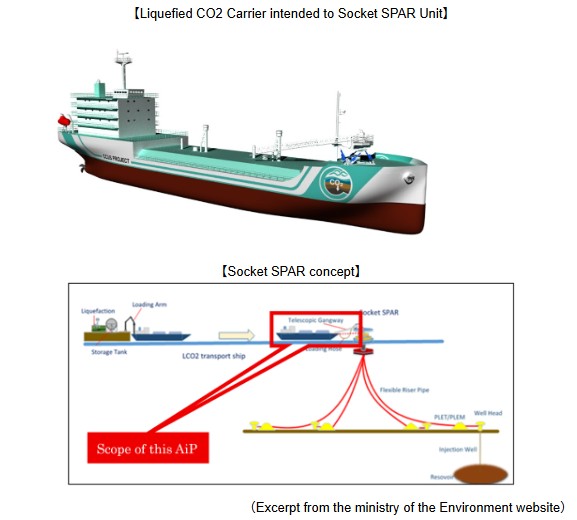
In the Socket SPAR concept, a floating offshore structure called a 'Socket SPAR' is installed at the offshore CO2 storage site. Liquefied CO2 is transferred from the CO2 carrier to the Socket SPAR, through which it is injected into the reservoir below the seabed. The large gangways are installed on the CO2 carrier, allowing workers to board the Socket SPAR during CO2 injection operation.
(Note: The scope of this AiP covers only the CO2 carrier, shown in the red box in the conceptual illustration.)
In this project, CO2 test facilities were used to obtain specific conditions and data to determine whether safety relief valves and piping could become clogged due to the unique properties of CO2, specifically when it turns into dry-ice. The test data were analyzed and incorporated into the vessel design in consultation with ClassNK.
Furthermore, cooling tests and re-liquefaction tests under low-temperature and low-pressure conditions were conducted to verify whether dry-ice formation could cause clogging. These tests confirmed that liquefied CO2 could be stably maintained over extended periods without operational issues, with future long-distance CO2 transportation also taken into consideration.
Building on the knowledge gained through this AiP, Shin Kurushima Sanoyas Shipbuilding will continue to advance research and development to meet future demand for CO2 transportation. Furthermore, by leveraging both our shipbuilding business and gas tank business as two core pillars, the company remains committed to addressing diverse needs related to reducing environmental impact and supporting the realization of a sustainable society.
■ Contact: ClassNK www.classnk.com